
Magic Bullet and NutriBullet look almost the same: a small motor base, an upside-down cup and a push-down blade. They’re even made by the same company. But they’re built for different jobs, and picking the wrong one is the most common reason people end up disappointed with a personal blender. This guide explains the difference, compares the magic bullet with the NutriBullet 600 and NutriBullet Pro 900, and helps you choose. It’s based on the manufacturer specs and Amazon listings, not our own lab tests.
Quick answer
- Choose the magic bullet if you want a small, budget-tier kitchen helper for sauces, dips, dressings, salsas and simple shakes with soft fruit and liquid.
- Choose the NutriBullet 600 if you make smoothies with fruit and leafy greens most days and want the classic, simple NutriBullet.
- Choose the NutriBullet Pro 900 if your smoothies include frozen fruit, nuts, seeds or kale. The extra power makes the biggest difference with tough, cold ingredients.
Same company, different jobs
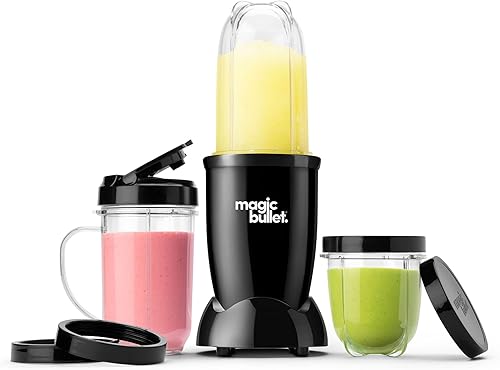
Both brands come from the same parent company. The original magic bullet was sold as a do-everything mini food prep tool: chopping, mixing, whipping and quick blending. The listing describes it as a way to “blend, mix, and chop your favorite foods in seconds,” and the kit comes with a party mug and Stay-Fresh resealable lids for storing dips and sauces.
NutriBullet came later and is designed around one main job: smoothies. It uses a stronger motor and what the brand calls an Extractor blade, which is designed to break down whole fruits and vegetables, including the fiber, into a drinkable smoothie.
So it’s less a question of “which is better” and more “which job do you need done.”
Comparison table
| magic bullet (MBR-1101AK) | NutriBullet 600 (NBR-0601WM) | NutriBullet Pro 900 | |
|---|---|---|---|
| Motor (per listing) | 250 W | 600 W (listing also cites 700 peak watts) | 900 W |
| Main cup | 22 oz tall cup | 24 oz cup (title also lists an 18 oz cup) | Pro cups |
| Blade | Stainless cross-blade | Extractor blade | Extractor blade |
| What else is in the box | Short cup, party mug, 2 lip rings, 2 Stay-Fresh lids, to-go lid, recipe guide | To-go lid, lip ring, recipe book | Cups, lids, recipe guide |
| Best for | Sauces, dips, dressings, soft-fruit shakes | Everyday fruit and greens smoothies | Frozen fruit, nuts, seeds, kale |
| Warranty (per listing) | 1-year limited | Check listing | Check listing |
| Tier | Budget | Budget | Budget to mid |
Note on wattage: NutriBullet’s listing for the 600 model is titled 600W while its bullet points mention 700 peak watts. Brands measure power differently, so use wattage as a rough guide between models from the same company rather than a precise number.

Smoothies with frozen fruit and greens: where 250W falls short
This is the most important difference. A 250-watt motor is fine for soft ingredients and plenty of liquid: a banana-and-milk shake, a vinaigrette, pesto or hummus in small batches. Where it struggles is with dense, cold or fibrous ingredients, such as a cup of frozen berries, ice, raw kale, or nuts and seeds. You’ll often end up shaking the cup, adding more liquid, or blending in short bursts.
The NutriBullet 600 is built for exactly those smoothies, and the Pro 900 has more headroom again. NutriBullet’s listing says the Pro handles “dense whole foods like nuts, seeds, hard fruits, and kale.” If your goal is a smooth green smoothie with frozen fruit every morning, skip the magic bullet and choose a NutriBullet. For a deeper look at the NutriBullet range, see our NutriBullet review.

Size, noise, cleanup, cups and accessories
Size. All three are compact and fit easily under cabinets. The magic bullet base is the smallest, and the NutriBullets are a little taller with their bigger cups.
Noise. Neither brand publishes decibel ratings for these models. In general, the more powerful the motor, the louder a blender tends to be, but all three run only for short bursts.
Cleanup. All three are easy: twist off the blade, rinse it with soap and water, and put the cups on the top rack of the dishwasher. Both brands say this on their listings. Don’t put the blade or the base in the dishwasher.
Cups and accessories. The magic bullet kit is the more varied set: a tall cup, short cup, party mug, lip rings, resealable lids and a to-go lid. That’s why it works as a mini food-prep kit. The NutriBullet kits are smoothie-focused, with a main cup, to-go lid and recipe book.
Operation. All three work the same way: push the cup down and twist to lock, and the blender runs while it’s engaged. There are no programs or speed settings.
How to choose in 30 seconds
Ask yourself three questions. First, what goes in the cup most days? If the answer is frozen fruit, ice, kale, nuts or seeds, you want a NutriBullet, and the Pro 900 if those ingredients show up daily. If it’s soft fruit, yogurt, milk or protein powder, any of the three will work. Second, do you want a smoothie maker or a mini prep tool? The magic bullet’s party mug, short cup and resealable lids make it handy for salsas, dips, dressings, which is a job the NutriBullets aren’t packaged for. Third, how many people are you blending for? All three are single-serve machines. If you regularly make smoothies for two or more people, a full-size countertop blender with a pitcher will save you from blending in rounds; our personal blender guide also covers countertop systems that come with to-go cups.
A practical tip for any of these: load the cup with liquid and soft ingredients first, then greens, then frozen items on top. When the cup is flipped onto the base, the frozen pieces end up farthest from the blade at the start and the liquid near the blade gets things moving, which helps lower-powered motors in particular.
Where Ninja fits
Ninja’s personal blenders (the Nutri Ninja line) compete directly with NutriBullet. They tend to offer more programs and different blade designs, and some models come as countertop systems with personal cups. If you’re also considering Ninja, our Nutri Ninja vs NutriBullet comparison covers that matchup, and our best personal blenders guide rounds up the top picks across brands.
FAQ
Can a magic bullet crush ice?
It isn’t designed as an ice crusher. With a 250-watt motor it’s best with soft ingredients and liquid. If you add ice, use a few cubes with plenty of liquid and blend in short pulses, and check the instruction manual for the brand’s guidance. If frozen drinks are a priority, a NutriBullet Pro 900 or a full-size blender is a better choice.
Are magic bullet and NutriBullet cups interchangeable?
Don’t assume they are. Even though the two brands look similar, the cups, blades and bases are designed for their own systems, and we couldn’t confirm official cross-compatibility from the manufacturer. Use the cups and blades made for your model, and buy replacements from the matching product line.
Is the NutriBullet Pro worth it over the NutriBullet 600?
If you use frozen fruit, nuts, seeds or kale regularly, yes. The extra power helps with dense ingredients. If you mostly blend soft fruit, yogurt and milk, the 600 is enough.
Which is better for protein shakes?
Either NutriBullet works well for protein shakes with fruit. A magic bullet is fine for simple powder-and-milk shakes.
Bottom line
The magic bullet is a budget-tier mini prep tool for sauces, dips and simple shakes. For real smoothies, choose a NutriBullet: the NutriBullet 600 for everyday fruit and greens, or the NutriBullet Pro 900 if you blend frozen fruit, nuts and kale.
As an Amazon Associate, we earn from qualifying purchases.